Category: E-Learning

  • Evolving Your Risk Management Strategies: Before and After RiskSmart Hub

    Evolving Your Risk Management Strategies: Before and After RiskSmart Hub

    Risk and resilience management training is more important than ever before for organisations, in an ever-evolving environment where uncertainty is the only certainty. It’s crucial that organisations not only implement their training, but to do so efficiently and effectively.

    In the past, traditional methodologies dominated the industries approach to risk management training – but offered limited scope for flexibility and personalisation. However, new advancements in risk and resilience management training e-learning platforms provide a revolutionary approach that is flexible, cost-effective, and completely remote.


    The Traditional Approach: Inflexible, Time-Consuming, and Costly

    emergency exercise

    Traditional risk and resilience management training is delivered through instructor-led sessions, workshops, seminars, and even off-site trainings. These delivery methods, while comprehensive, often fail to account for the unique needs, constraints, and preferences of individual learners or organisations. The in-person nature of traditional training methods also present their own set of challenges.

    These methods are limited by geographic constraints. Learners must be in a specific location at a specific time to participate in training. The logistics of coordinating schedules and gathering multiple individuals in one place results in significant time consumption and often leads to delays.

    Traditional training methods also lack flexibility. The training’s pace is dictated by the curriculum set for the time allotted. Learners who may need more time to absorb certain concepts of traditional training methods don’t have the luxury of learning at their preferred pace and are instead forced to keep up with the classroom.

    Costs are also a significant issue of traditional training methods. Beyond the training fees themselves, additional costs such as travel, venue booking or even getting renowned experts on board can price many organisations out of top-tier risk management training.


    e-Learning & RiskSmart Hub: A Better Way Forward

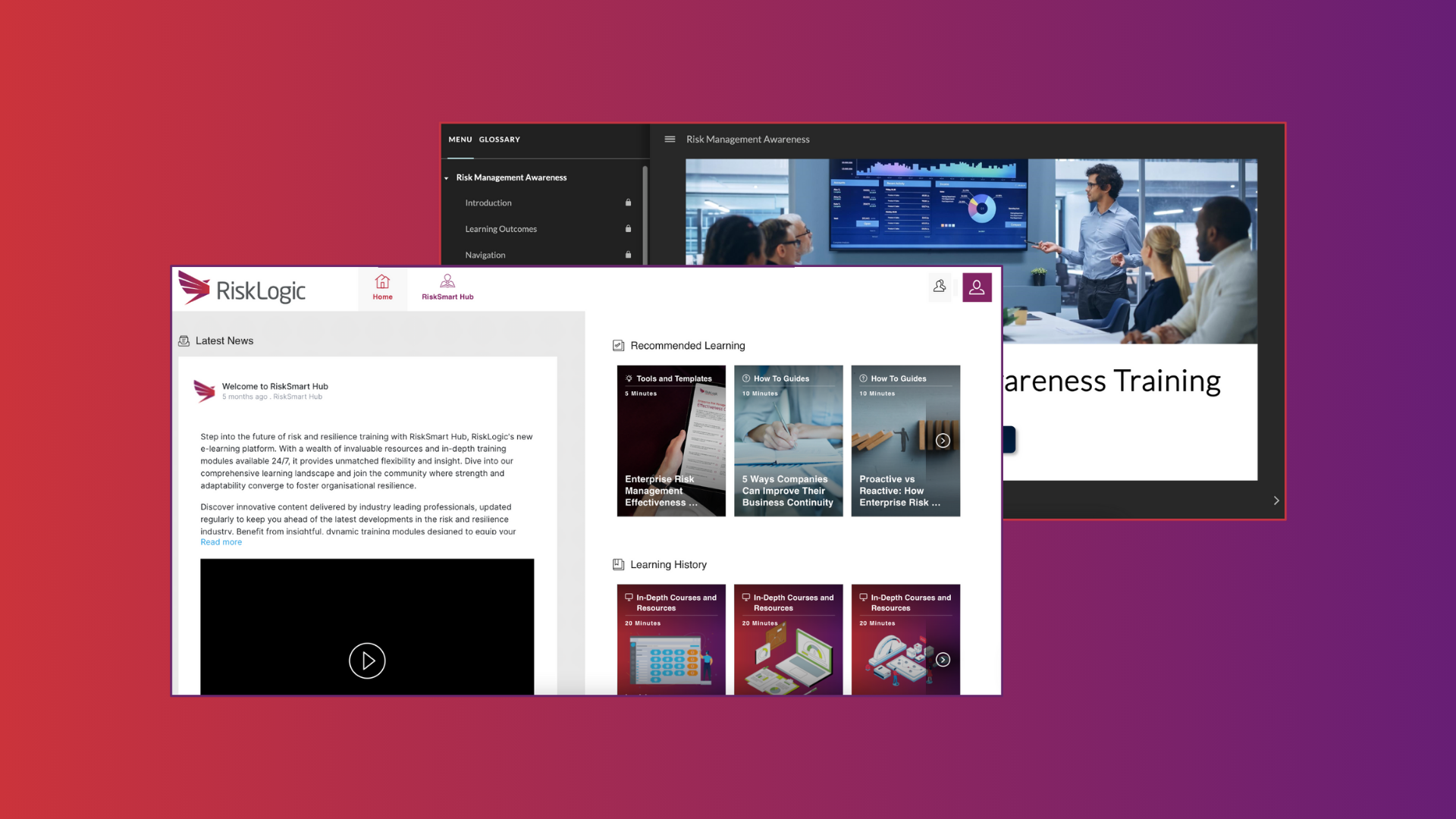
    RiskSmart Hub revolutionises the landscape of risk and resilience management training, addressing the shortcomings of traditional methodologies through a flexible, cost-effective, and remotely accessible solution.

    The most evident benefit is the elimination of logistical constraints. RiskSmart Hub, as an online e-learning platform, can be accessed from anywhere, at any time, from any device. This flexibility allows individuals to learn at their convenience, ensuring an uninterrupted work schedule which does not need to adapt to an allotted training schedule.

    RiskSmart Hub’s diverse course categories cater to a broad range of organisational needs and knowledge levels, from the basic foundations of risk and resilience management to in-depth nuances. The training can be personalised to everyone’s pace, as opposed to the ‘one-size-fits-all’ approach of traditional training.

    Beyond that, RiskSmart Hub delivers a breadth of interactive and engaging content, which improves learner retention and deepens their understanding of the course material.

    RiskSmart Hub is also a more cost-effective and affordable option. Without physical logistic costs, it is cheaper to run, making it a great choice for organisations with tighter training budgets. It provides world-class risk and resilience management training that’s accessible to all.

    Notably, RiskSmart Hub also makes it easier to measure and track learner progress. Comprehensive learning history allows learners to easily access what they have previously learnt through the platform – something that is far more difficult with traditional training methods.


    An Evolution in Risk and Resilience Management Training

    Transitioning from traditional methods to risk and resilience management training with RiskSmart Hub entails not just adopting a new platform, but embracing a shift in how we view and approach training in the risk and resilience management industry.

    RiskSmart Hub’s approach offers flexibility, customisation, and accessibility – countering the inflexibility and high costs of traditional methods. You’re no longer just providing training but optimising the process of learning and empowering your teams with the tools to handle risk more effectively.


     

    Contact Our Expert Team

    Learn More About RiskSmart Hub

  • Building Resilience: Why Investing in Organisational ERM Training is Essential

    Building Resilience: Why Investing in Organisational ERM Training is Essential

    Previously, we explored the transformative potential of e-learning in building resilient organisations. Today, as we delve deeper, we move our focus to one of the key facets of resilient organisations – Enterprise Risk Management (ERM). The value of effective ERM cannot be understated. 

    Here’s why investing in organisational ERM training should be a priority and how our risk and resilience management e-learning platform, RiskSmart Hub, can help. 


    Emerging Trends and The Need for ERM

    Cyber threats, regulatory changes, and geopolitical uncertainty are only some of the current rapidly evolving challenges facing organisations today. In this context, a robust ERM strategy and framework serves as the lynchpin that holds the organisation firm amidst fluctuating risks. 

    Employee capability to deal effectively with these uncertainties plays a crucial role here. ERM training equips organisations with the skills and knowledge to identify, assess, and manage risks, ultimately steering them towards resilience. 


    The ERM Advantage

    Investing in ERM training yields several advantageous outcomes for organisations including: 


    Improved Decision-Making:  

    One of the key advantages of ERM training is the profound impact it has on decision-making within the organisation. Employees who have undergone in-depth ERM programs possess a comprehensive understanding of risk factors that dynamically influence the organisation’s operational environment.  

    This knowledge lets them consider not just isolated risks, but the entire spectrum of interrelated uncertainties that can affect the organisation’s prospects. From strategic decisions like product expansion or market entry to tactical choices like supplier selection or cost control measures, ERM-educated employees can weigh potential risks against potential rewards more effectively.  

    Furthermore, these employees are equipped with tools and methodologies enabling them to quantify the impact of identified risks. They can use scenario analysis and risk assessments to make more empirical and data-driven choices. This is a significant shift from instinct-driven decisions to an evidence-based approach that heavily relies on analysis and foresight. 

    A holistic understanding of risks also motivates ERM-trained individuals to explore alternative solutions and implement innovative strategies. This cultivation of innovative thought often results in novel solutions that can give an organisation a competitive edge in the market.  

    ERM training fundamentally transforms the decision-making landscape within an organisation. It equips employees with the ability to make informed choices and consider a broad spectrum of risks and opportunities to drive overall organisational performance and resilience. 


    Risk Culture:  

    One of the most transformative outcomes of integrating ERM training is the development of a proactive risk culture. This culture, fuelled by knowledge and underpinned by precaution, encourages employees at all levels of the hierarchy to actively participate in risk management efforts. 

    A robust risk culture doesn’t happen overnight but is the result of consistent reinforcement of risk awareness, starting from top management and permeating throughout the workforce. With ERM training, employees become well-versed in identifying and understanding the risks inherent in their roles, their departments, and the broader business landscape. This understanding cultivates a sense of responsibility and ownership, empowering employees to mitigate risks proactively. 

    The fostering of a proactive risk culture does not only act as a strong preventative force against potential threats but also as a driving force for progressing towards organisational resilience. By embedding risk management principles into the everyday culture, ERM training ensures that the organisation is prepared, aware, and armed to face any prospective challenges head-on. 


    Competitive Advantage: 

    Developing and embedding a comprehensive, resilient risk management framework with ERM training not only shields an organisation from potential threats, but uniquely positions it for significant competitive advantage in the marketplace. This advantage is multifaceted – heightened decision-making capabilities, increased operational efficiencies, improved reputation, and the capacity to seize opportunities others might avoid due to perceived risks. 

    ERM training transforms risk response from being merely reactive to pre-emptive and strategic. This strategic focus can differentiate an organisation, enabling it to navigate and capitalise on situations where competitors without such foresight might falter. 

    Embedding ERM practices in an organisation naturally leads to improved operational efficiencies. ERM-trained employees are adept at identifying risks present in operational processes – risks that, left unaddressed, could result in process inefficiencies, cost overruns, quality concerns, and wasted resources. By proactively identifying, assessing, and addressing these risks, organisations will be better placed to streamline operations and reduce costs, thereby gaining a strategic advantage over competitors. 

    A robust ERM framework positively impacts an organisation’s reputation. Stakeholders are more likely to trust and invest in organisations that transparently manage and communicate about risks. A reputation for being a resilient, well-managed business can create preferential treatment in competitive situations. 


    Leveraging E-Learning for ERM Training

    In today’s digital age, e-learning platforms are revolutionising the way organisations approach upskilling and capability development. Our newly launched RiskSmart Hub platform is a testament to this, designed to significantly enhance risk and resilience management education conveniently and effectively.  

    Interweaving technology and education, RiskSmart Hub offers flexible learning modules, articles, how to guides, tools and templates, exclusive discussions, and more that accommodate the diverse work schedules of today’s professionals. The platform’s versatile nature allows employees to control the pace and location of their learning journey, making ERM training more accessible and ensuring no individual is left on the sidelines.  

    But it isn’t just flexibility that sets RiskSmart Hub apart. The real advantage lies in the relevance and depth of the content offered and curated by our team of world-class risk and resilience management consulting experts. Our content isn’t derived from mere theory. It stems from real business scenarios, recent case studies, latest regulatory updates, and emerging risk trends. The amalgamation of these aspects guarantees learners receive up-to-date, practical knowledge that can readily be applied to their day-to-day work.  

    RiskSmart Hub is not only facilitating the enhancement of risk awareness and abilities within organisations but actively making ERM training a part of employees’ professional growth. Through such a platform, we are working towards a future where every organisation is resilient, informed and confidently navigating ahead, irrespective of the complexity of the challenges they face. 


    Investing in organisational resilience and ERM training is not just a buffer against adversity; it’s a strategic decision that propels success. With RiskSmart Hub, we aim to facilitate this learning journey for organisations and give them the confidence to navigate any storm. 


    Experience RiskSmart Hub Today —>

    Learn More About Enterprise Risk Management

  • Sharpening Your Business Edge: The Importance of Risk and Resilience E-Learning In Today’s Landscape

    Sharpening Your Business Edge: The Importance of Risk and Resilience E-Learning In Today’s Landscape

    The business landscape of today is more dynamic and unpredictable than ever before. Rapid technological advancements, shifting market dynamics, and an escalating geopolitical flux have given rise to a new generation of risks, demanding a fresh approach towards organisational resilience. To adapt, survive, and thrive amidst this complexity, organisations must evolve their learning to match this pace of change. That’s where risk and resilience e-learning comes into play. 


    E-learning: Your Power-Tool for Risk & Resilience 

    E-learning has emerged as a powerful tool for organisations to navigate the changing nature of risk. It offers the flexibility and accessibility that modern businesses need to address the rising trends of remote work and geographically distributed teams. The ability to provide risk and resilience education to employees, irrespective of their location, encourages a seamless, organisation-wide culture of risk-awareness. 

    Flexibility notwithstanding, e-learning’s real strength lies in its capacity to offer tailored training modules. It can draw from a variety of learning structures and methodologies, thereby offering a highly immersive learning experience. 


    Nurturing A Risk-Aware Culture With E-Learning  

    Nurturing a risk-aware culture goes beyond one-off training sessions. It calls for continuous learning and updating of knowledge. An e-learning platform fills this gap effectively. Such a platform not only provides the foundational knowledge of risk and resilience but continually updates course content to reflect new developments in the field. This way, businesses can ensure their employees’ knowledge of risk management remains fresh and relevant. 

    Another distinct advantage of e-learning is its ability to cater to a diverse audience. From senior management to operational staff, e-learning platforms can be leveraged to roll out risk and resilience training that suits the specific learning requirements of all levels of the organisation. This fosters a comprehensive culture of risk-awareness, where every employee understands their role in managing and mitigating risks. 


    RiskSmart Hub: Your Companion for Risk and Resilience E-Learning 

    Recognising the definitive role of e-learning in building risk and resilience management, we have launched our e-learning platform, RiskSmart Hub. Designed with industry-leading insights, this platform offers organisations the ability to train their teams in risk and resilience management effectively and efficiently. 

    RiskSmart Hub’s modules are not just about risk identification and analysis. They extend to holistic risk management, covering areas such as strategic risk appetite, risk governance and creating a risk-aware culture. The platform also accommodates busy schedules with flexible learning modules that employees can engage with at their own pace. 


    In an era characterised by complexity and change, the importance of training in risk and resilience cannot be overstated. By leveraging e-learning, organisations cannot just circumnavigate potential threats but turn them into opportunities for growth and innovation. In essence, the right e-learning platform can be a gamechanger, sharpening your business edge and paving the way for long-term success amidst uncertainty. 

    Experience RiskSmart Hub Today —>

    Get In Touch With RiskLogic

  • Investing In Your Team: Building a Resilient Organisation Through Effective E-Learning

    Investing In Your Team: Building a Resilient Organisation Through Effective E-Learning

    In today’s fast-paced, constantly evolving corporate landscape, it is increasingly vital for organisations to invest in their teams, sharpen skills, and enhance capabilities. More than ever, hiring managers are shifting their attention towards learning and development activities – a clear indication of the value of this aspect of the human resource strategy.

    An integral part of this dynamic is Enterprise Risk Management (ERM) and Organisational Resilience (OR) training which encompasses facets such as risk management processes and tools, business continuity management and crisis management. In this realm, e-learning emerges as a formidable tool.


    The Value of E-Learning in ERM & OR Training

    In recent years, e-learning has drastically transformed the landscape of professional education. With digitally delivered courses, staff can now harness new knowledge and skills more efficiently than traditional classroom-based approaches. It’s no surprise then, that e-learning has found so much value in ERM and OR training.

    One of the most significant advantages of e-learning is its flexibility. Training modules can be accessed anytime and from anywhere – from the comfort of home, during commutes, or during work breaks. This allows employees to fit learning into their personal schedules. In a world where work-life balance is increasingly valued, the flexibility of e-learning cannot be overstated.

    The accessibility of e-learning is equally crucial. Regardless of geographical location, employees can access critical risk management training materials. Such global reach ensures that even remote staff are just as skilled and informed as their office-based counterparts. With e-learning, geographical distances pose no hindrance to the organisation-wide dissemination of essential ERM and OR knowledge.

    E-learning additionally allows for individualised learning experiences. People absorb information at different rates; what might be clear to one person may be challenging for another and e-learning platforms allow learners to progress through training modules at their own pace.

    Additionally, the digital nature of e-learning allows for quick content updates, thereby ensuring that training material is always current. In the rapidly changing risk environment, this feature is invaluable. Employees can therefore always stay up-to-date and adequately be prepared with the latest risk management strategies and practices.

    RiskSmart Hub is our brand-new e-learning platform enthusiastically developed with these advantages in mind. It focuses on staff capabilities, risk awareness training, business continuity, crisis management, and comprehensive enterprise risk management — all the pillars required for building a resilient organisation.


    Investing in Staff Capabilities

    Investing in staff capabilities, particularly in ERM and OR, has never been more critical than in today’s dynamic and complex business environment. Essential capabilities include understanding and identifying potential risks, planning appropriate responses, and implementing effective risk management solutions. These skills are not instinctive; instead, they are developed and refined through comprehensive training.

    To truly excel in risk response, employees need the facility to recognise the first signs of a potential risk, to sidestep or minimise harm, and to develop an agile, adaptive strategy that mitigates its impact. The fluidity of the modern business landscape, characterised by changing regulations, evolving technologies, and emerging threats, necessitate continuous learning.

    Investments in comprehensive training platforms facilitate such continuous learning. Far beyond the classroom, they provide extensive content, tools, and strategies tailored to a variety of learning styles and paces. These resources enable staff to dive deeper into the concepts of ERM and OR, to explore case studies, to apply their knowledge in real-life scenarios, and to test themselves through interactive quizzes.


    The Importance of Risk Awareness Training

    When staff augment their risk awareness, they are better equipped to discern potential risk signals that may lurk beneath daily work activities. These signals could be subtle changes in patterns, aberrations in data, irregularities in communication or sudden market changes. A risk aware individual will recognise these anomalies as potential threats, thus averting the risk before it manifests into a crisis for their organisation.

    Risk awareness is also invaluable for interpreting the consequences of such risks. A risk aware team member will understand the potential short-term and long-term implications of risks, or how they could echo throughout the entire organisation. They will appreciate how a risk in one department can cascade onto others, the potential damage to the company’s reputation, or how it could affect the company’s financial buoyancy.

    Effective response is another crucial aspect shaped by risk awareness. The more risk aware employees are, the quicker and more adaptively they can respond to risks. This aspect is vital because speed is often of the essence in risk management. Swift actions can prevent minor issues from snowballing into larger problems, ensuring that the organisation remains resilient in the face of threats.

    Implementing interactive e-learning modules paves the way for this much-needed risk awareness training. These modules help provide staff with a clear and comprehensive understanding of ERM and OR. Such modules help make the learning experience more engaging and memorable, ensuring the practical application of risk awareness in day-to-day operations.


    Making an investment in your team through e-learning is an investment in your organisation. By facilitating continuous learning and growth, you are building a stronger, more resilient brand. With RiskSmart Hub, you can provide your team with the skills they need to face challenges head-on and to leverage risk for organisational success.

    Experience RiskSmart Hub Today —>